
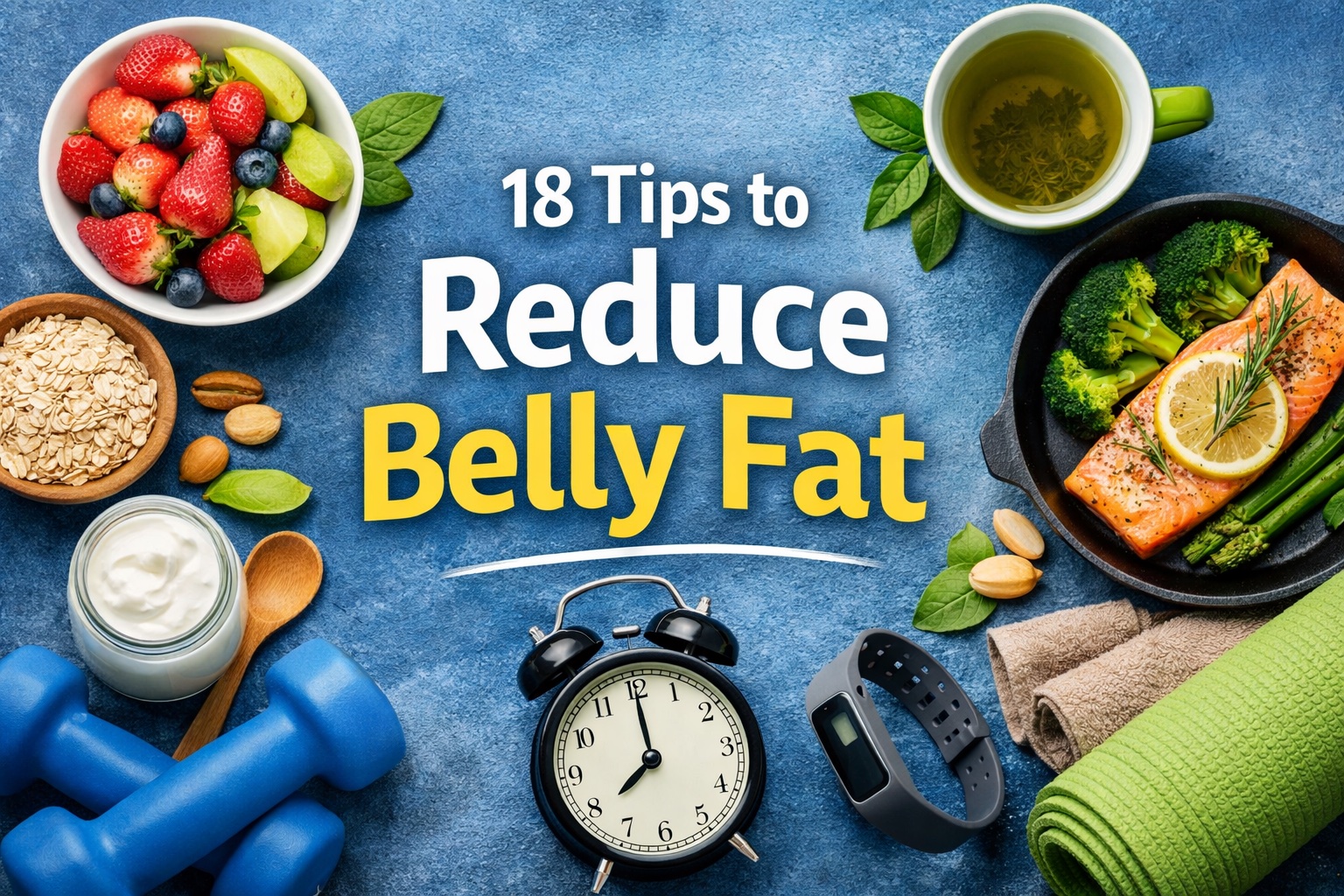
Belly fat is not just about appearance.
Excess fat around the abdomen, especially visceral fat (the type that surrounds your internal organs), has been linked to increased risk of metabolic conditions such as type 2 diabetes, cardiovascular disease, and insulin resistance.
While many people focus only on weight or BMI, research shows that where fat is stored matters just as much as how much you weigh.
Losing belly fat can feel frustrating, but the good news is this:
You don’t need extreme diets, punishing workouts, or short-term hacks.
What works best is a series of small, evidence-based shifts applied consistently over time.
Below are 18 practical, science-supported strategies that may help reduce abdominal fat while supporting overall health.
1. Increase Your Intake of Soluble Fiber
Soluble fiber absorbs water and forms a gel-like substance in the gut, slowing digestion and helping you feel full longer.
Research suggests that higher soluble fiber intake is associated with reduced accumulation of belly fat over time.
Good sources include:
- Oats and barley
- Beans and lentils
- Fruits such as apples, citrus, and berries
- Vegetables like carrots and Brussels sprouts
👉 Focus on adding fiber, not cutting food.
2. Avoid Trans Fats as Much as Possible
Trans fats are artificial fats created through hydrogenation. They’ve been linked to inflammation, insulin resistance, and increased abdominal fat storage.
Although many manufacturers have reduced their use, trans fats may still appear in:
- Packaged baked goods
- Fried foods
- Margarines
Check labels for “partially hydrogenated oils.”
3. Be Mindful With Alcohol
Moderate alcohol consumption may fit into a healthy lifestyle, but excessive or binge drinking has been associated with greater waist circumference.
Instead of focusing on elimination, try:
- Limiting quantity per sitting
- Avoiding sugary mixers
- Choosing alcohol-free days each week
Consistency matters more than perfection.
4. Prioritize Protein at Every Meal
Protein supports satiety, muscle maintenance, and metabolic health.
Studies suggest that diets higher in protein are associated with less visceral fat compared to lower-protein patterns.
Quality protein sources include:
- Eggs
- Fish
- Lean meats
- Dairy
- Beans and legumes
Aim for balance, not extremes.
5. Manage Stress Levels
Chronic stress increases cortisol, a hormone associated with fat storage around the abdomen.
Helpful stress-reducing practices include:
- Walking outdoors
- Deep breathing
- Yoga or stretching
- Short mindfulness sessions
Reducing stress doesn’t just help your mind, it may help your waistline too.
6. Limit Added Sugars
Excess sugar intake, especially fructose, has been linked to fatty liver and abdominal fat accumulation.
This includes:
- Sweets and desserts
- Sugary snacks
- Sweetened sauces
Even natural sweeteners should be used in moderation.
7. Include Aerobic Exercise
Cardio supports fat loss, cardiovascular health, and insulin sensitivity.
Examples:
- Brisk walking
- Cycling
- Swimming
- Jogging
Research suggests duration and consistency matter more than intensity alone.
Some scientists are currently studying how cold signals may influence fat tissue behavior, especially in the abdominal area.
If you’re curious, there’s a short video explaining this concept in simple terms.
👉 You can watch it here if you want to learn more.
8. Reduce Refined Carbohydrates
Replacing refined carbs with whole, minimally processed sources may support metabolic health and belly fat reduction.
Swap:
- White bread → whole grain bread
- Sugary cereals → oats
- Pastries → fruit or nuts
You don’t need to eliminate carbs, just choose better ones.
9. Add Resistance Training
Strength training helps preserve lean muscle mass and may support reductions in visceral fat when combined with other lifestyle changes.
Simple options:
- Bodyweight exercises
- Resistance bands
- Light weights
Muscle is metabolically active and supports long-term fat balance.
10. Avoid Sugary Drinks
Liquid calories don’t trigger fullness the same way solid food does.
Limit:
- Soda
- Sweet tea
- Fruit drinks
- Sugary coffee beverages
Choose water, unsweetened tea, or sparkling water instead.
11. Get Enough Quality Sleep
Sleep deprivation has been associated with increased hunger hormones and belly fat gain.
Aim for:
- 7–9 hours per night
- Consistent sleep and wake times
- Minimal screen exposure before bed
Good sleep is a fat-loss multiplier, not a luxury.
12. Track Food and Movement (Lightly)
Awareness drives change.
You don’t need to obsess, but occasional tracking can help you:
- Notice patterns
- Identify hidden calories
- Adjust portions naturally
Think curiosity, not control.
13. Eat Fatty Fish Regularly
Fatty fish provides omega-3 fatty acids, which may help reduce visceral fat and support metabolic health.
Good options:
- Salmon
- Sardines
- Mackerel
- Anchovies
2–3 servings per week is a solid goal.
14. Limit Fruit Juice
Fruit juice often contains as much sugar as soda, without the fiber found in whole fruit.
Whole fruit > juice.
If you drink juice, keep portions small.
15. Support Gut Health With Probiotics
Emerging research suggests that gut bacteria balance may influence fat storage.
Sources include:
- Yogurt
- Kefir
- Sauerkraut
- Kimchi
Probiotics may support belly fat reduction indirectly through digestion and inflammation control.
16. Experiment Carefully With Intermittent Fasting
Some people find intermittent fasting helpful, others don’t.
Possible benefits:
- Improved insulin sensitivity
- Reduced calorie intake
Listen to your body and consult a healthcare professional if unsure.
17. Drink Green Tea
Green tea contains antioxidants and compounds that may modestly support fat metabolism, especially when paired with physical activity.
It’s not magic, but it can be a supportive habit.
18. Focus on Lifestyle, Not One Trick
No single habit melts belly fat on its own.
The most sustainable results come from:
- Balanced eating
- Regular movement
- Stress management
- Quality sleep
When these align, fat loss often becomes a side effect, not a struggle.
If you prefer learning visually, there’s a brief video that walks through one emerging idea related to metabolic health and cold exposure.
No sign-up required.
No obligation.
Frequently Asked Questions
What burns belly fat the fastest?
There is no instant method. Long-term consistency beats short-term intensity.
Can I lose belly fat in 7 days?
You may reduce bloating, but real fat loss takes longer and should be gradual.
Are there specific foods that target belly fat?
No food targets fat directly, but fiber-rich, protein-dense, and anti-inflammatory foods support healthier fat distribution.
Is there a simple daily habit that supports metabolic activation?
Some researchers are exploring how brief exposure to cold temperatures may activate certain metabolic responses.
There is a short educational video that explains this approach in more detail, including why it’s different from exercise or calorie restriction.
👉 You can watch the explanation here if you’re interested.
The Takeaway
Reducing belly fat isn’t about punishment or perfection.
It’s about making small, intelligent shifts that your body can sustain.
When you focus on nourishment, movement, rest, and stress balance, your body often responds naturally.
If you have existing health conditions or concerns, consult a healthcare professional before making major changes.
A quiet note before you go
If you’ve ever wondered why belly fat seems more stubborn than fat elsewhere,
it may help to understand how body temperature and metabolic signaling influence fat storage.
We recently came across a short educational presentation that explains
a cold-exposure based approach some researchers are exploring in relation to metabolic activity.
It’s not a workout.
It’s not a diet.
And it doesn’t ask you to “push harder.”
👉 Watch the free presentation here to understand the idea
(educational content only)
Source:
- About moderate alcohol use. (2025).
https://www.cdc.gov/alcohol/about-alcohol-use/moderate-alcohol-use.html - Arciero PJ, et al. (2023). Intermittent fasting and protein pacing are superior to caloric restriction for weight and visceral fat loss.
https://pmc.ncbi.nlm.nih.gov/articles/PMC10107279/ - Akbar A, ET AL. (2023). High fat diet.
https://www.ncbi.nlm.nih.gov/books/NBK559033/ - Afzal M, et al. (2015). Green tea polyphenols and their potential role in health and disease.
https://pubmed.ncbi.nlm.nih.gov/26164000/ - Bacchi E, et al. (2013). Both resistance training and aerobic training reduce hepatic fat content in type 2 diabetic subjects with nonalcoholic fatty liver disease (the RAED2 Randomized Trial).
https://pubmed.ncbi.nlm.nih.gov/23504926/ - Basu T, et al. (2023). Current status of obesity: Protective role of catechins.
https://pmc.ncbi.nlm.nih.gov/articles/PMC9952428/ - Brobakken MF, et al. (2023). Abdominal aerobic endurance exercise reveals spot reduction exists: A randomized controlled trial.
https://pmc.ncbi.nlm.nih.gov/articles/PMC10680576/ - Busnatu SS, et al. (2022). The role of fructose as a cardiovascular risk factor: An update.
https://pmc.ncbi.nlm.nih.gov/articles/PMC8779080/ - Butler JL, et al. (2023). Associations of 5-year changes in alcoholic beverage intake with 5-year changes in waist circumference and BMI in the Coronary Artery Risk Development in Young Adults (CARDIA) study.
https://pmc.ncbi.nlm.nih.gov/articles/PMC9994756/ - Cho KH, et al. (2018). Association of sleep duration and obesity according to gender and age in Korean adults: Results from the Korea National Health and Nutrition Examination Survey 2007–2015.
https://pmc.ncbi.nlm.nih.gov/articles/PMC6306326/ - Dâmaso AR, et al. (2014). Aerobic plus resistance training was more effective in improving the visceral adiposity, metabolic profile and inflammatory markers than aerobic training in obese adolescents.
https://pubmed.ncbi.nlm.nih.gov/24730354/ - de Graaf C. (2011). Why liquid energy results in overconsumption.
https://www.cambridge.org/core/journals/proceedings-of-the-nutrition-society/article/why-liquid-energy-results-in-overconsumption/CF1F368BDC27A8871DC82040656FCE90 - Dorn J, et al. (2003). Alcohol drinking patterns differentially affect central adiposity as measured by abdominal height in women and men.
https://www.sciencedirect.com/science/article/pii/S0022316622160281?via%3Dihub - Dutheil F, et al. (2013). Different modalities of exercise to reduce visceral fat mass and cardiovascular risk in metabolic syndrome: The RESOLVE randomized trial.
https://pubmed.ncbi.nlm.nih.gov/23714599/ - FoodData Central. (2025).
https://fdc.nal.usda.gov/ - Friedenreich CM, et al. (2015). Effects of a high vs moderate volume of aerobic exercise on adiposity outcomes in postmenopausal women: A randomized clinical trial.
https://jamanetwork.com/journals/jamaoncology/fullarticle/2396584 - Garr Barry V, et al. (2021). Greater loss of central adiposity from low-carbohydrate versus low-fat diet in middle-aged adults with overweight and obesity.
https://pmc.ncbi.nlm.nih.gov/articles/PMC7911139/ - Geng J, et al. (2022). The links between gut microbiota and obesity and obesity related diseases.
https://www.sciencedirect.com/science/article/pii/S075333222200066X - Gill JMR, et al. (2014). Fruit juice: Just another sugary drink?
https://www.thelancet.com/journals/landia/article/PIIS2213-8587(14)70013-0/abstract - Hall KD, et al. (2021). Ultra-processed diets cause excess calorie intake and weight gain: An inpatient randomized controlled trial of ad libitum food intake.
https://pmc.ncbi.nlm.nih.gov/articles/PMC7946062/ - Heilbronn LK, ete al. (2022). Glucose tolerance and skeletal muscle gene expression in response to alternate day fasting.
https://onlinelibrary.wiley.com/doi/10.1038/oby.2005.61 - Hairston KG, et al. (2011). Lifestyle factors and 5-year abdominal fat accumulation in a minority cohort: The IRAS Family Study.
https://pmc.ncbi.nlm.nih.gov/articles/PMC3856431/ - Hervik AK, et al. (2019). The role of fiber in energy balance.
https://pubmed.ncbi.nlm.nih.gov/30805214/ - How high fructose intake may trigger fatty liver disease. (2020).
https://www.nih.gov/news-events/nih-research-matters/how-high-fructose-intake-may-trigger-fatty-liver-disease - Kühnel A, et al. (2023). Stress-induced brain responses are associated with BMI in women.
https://www.nature.com/articles/s42003-023-05396-8 - Lane, KE, et al. (2022). Bioavailability and conversion of plant based sources of omega-3 fatty acids – a scoping review to update supplementation options for vegetarians and vegans.
https://www.tandfonline.com/doi/full/10.1080/10408398.2021.1880364#abstract - Lin Y, et al. (2020). The effect of green tea supplementation on obesity: A systematic review and dose-response meta-analysis of randomized controlled trials.
https://pubmed.ncbi.nlm.nih.gov/19074207/ - López-Alarcón M, et al. (2014). Excessive refined carbohydrates and scarce micronutrients intakes increase inflammatory mediators and insulin resistance in prepubertal and pubertal obese children independently of obesity.
https://pmc.ncbi.nlm.nih.gov/articles/PMC4248360/ - McKeown NM, et al. (2010). Whole- and refined-grain intakes are differentially associated with abdominal visceral and subcutaneous adiposity in healthy adults: the Framingham Heart Study.
https://pmc.ncbi.nlm.nih.gov/articles/PMC2954448/ - Mo SY, et al. (2022). Effects of Lactobacillus curvatus Hy7601 and Lactobacillus plantarum Ky1032 on overweight and the gut microbiota in humans: randomized, double-blinded, placebo-controlled clinical trial.
https://www.mdpi.com/2072-6643/14/12/2484 - Moon J, et al. (2020). Clinical evidence and mechanisms of high-protein diet-induced weight loss.
https://pmc.ncbi.nlm.nih.gov/articles/PMC7539343/ - Neyestani TR, et al. (2022). A comprehensive overview on the effects of green tea on anthropometric measures, blood pressure, glycemic and lipidemic status: An umbrella review and meta meta-analysis study.
https://www.nmcd-journal.com/article/S0939-4753(22)00247-2/abstract - Pacifico L, et al. (2015). A double-blind, placebo-controlled randomized trial to evaluate the efficacy of docosahexaenoic acid supplementation on hepatic fat and associated cardiovascular risk factors in overweight children with nonalcoholic fatty liver disease.
https://pubmed.ncbi.nlm.nih.gov/26026214/ - Patel SR, et al. (2006). Association between reduced sleep and weight gain in women.
https://pmc.ncbi.nlm.nih.gov/articles/PMC3496783/ - Pipoyan D, et al. (2021). The effect of trans fatty acids on human health: Regulation and consumption patterns.
https://pmc.ncbi.nlm.nih.gov/articles/PMC8535577/ - Probiotics: Usefulness and safety. (2019).
https://www.nccih.nih.gov/health/probiotics-usefulness-and-safety - Salman HB, et al. (2022). The effect of omega-3 fatty acid supplementation on weight loss and cognitive function in overweight or obese individuals on weight-loss diet.
https://pubmed.ncbi.nlm.nih.gov/35815739/ - Soenen S, et al. (2013). Normal protein intake is required for body weight loss and weight maintenance, and elevated protein intake for additional preservation of resting energy expenditure and fat free mass.
https://www.sciencedirect.com/science/article/pii/S0022316622011828?via%3Dihub - Spring B, et al. (2013). Integrating technology into standard weight loss treatment: A randomized controlled trial.
https://pmc.ncbi.nlm.nih.gov/articles/PMC3684245/ - Tseng TS, (2021). Sugar intake from sweetened beverages and diabetes: A narrative review.
https://pmc.ncbi.nlm.nih.gov/articles/PMC8472506/ - Veit M, et al. (202 ). The role of dietary sugars, overweight, and obesity in type 2 diabetes mellitus: A narrative review.
- Warne JP, et al. (2009). Shaping the stress response: Interplay of palatable food choices, glucocorticoids, insulin and abdominal obesity.
https://www.sciencedirect.com/science/article/abs/pii/S0303720708004498?via%3Dihub - Xu X, et al. (2024). Association between metabolic score for visceral fat and obstructive sleep apnea: a cross-sectional study.
https://pmc.ncbi.nlm.nih.gov/articles/PMC11669583/ - Yamazaki H, et al. (2022). Fat distribution patterns and future type 2 diabetes.
https://diabetesjournals.org/diabetes/article/71/9/1937/147108/Fat-Distribution-Patterns-and-Future-Type-2 - Yao F, et al. (2022). Age and sex differences in the association of sleep duration and overweight/obesity among Chinese participants age above 45 years: A cohort study.
https://pubmed.ncbi.nlm.nih.gov/35842762/
Leave a Reply